Unconditional Finance builds control and confidence with Salestrekker 2.0

Keeping a high-volume business on track
Unconditional Finance has grown into a high-volume broking business with a clear focus on process, training and control.
That growth sits behind a business with a serious track record. Unconditional Finance has been recognised across industry and local awards, including Top Mortgage Employer, Fast Brokerages, Outstanding Professional Services, SFG Best Independent Office, and major individual wins for Chris Raymond and Stephanie Coleman.
The business has been operating for nine years and settled half a billion dollars in loans in the last financial year. With an average loan size of around $520,000, that result reflects a large number of applications moving through the business at any one time.
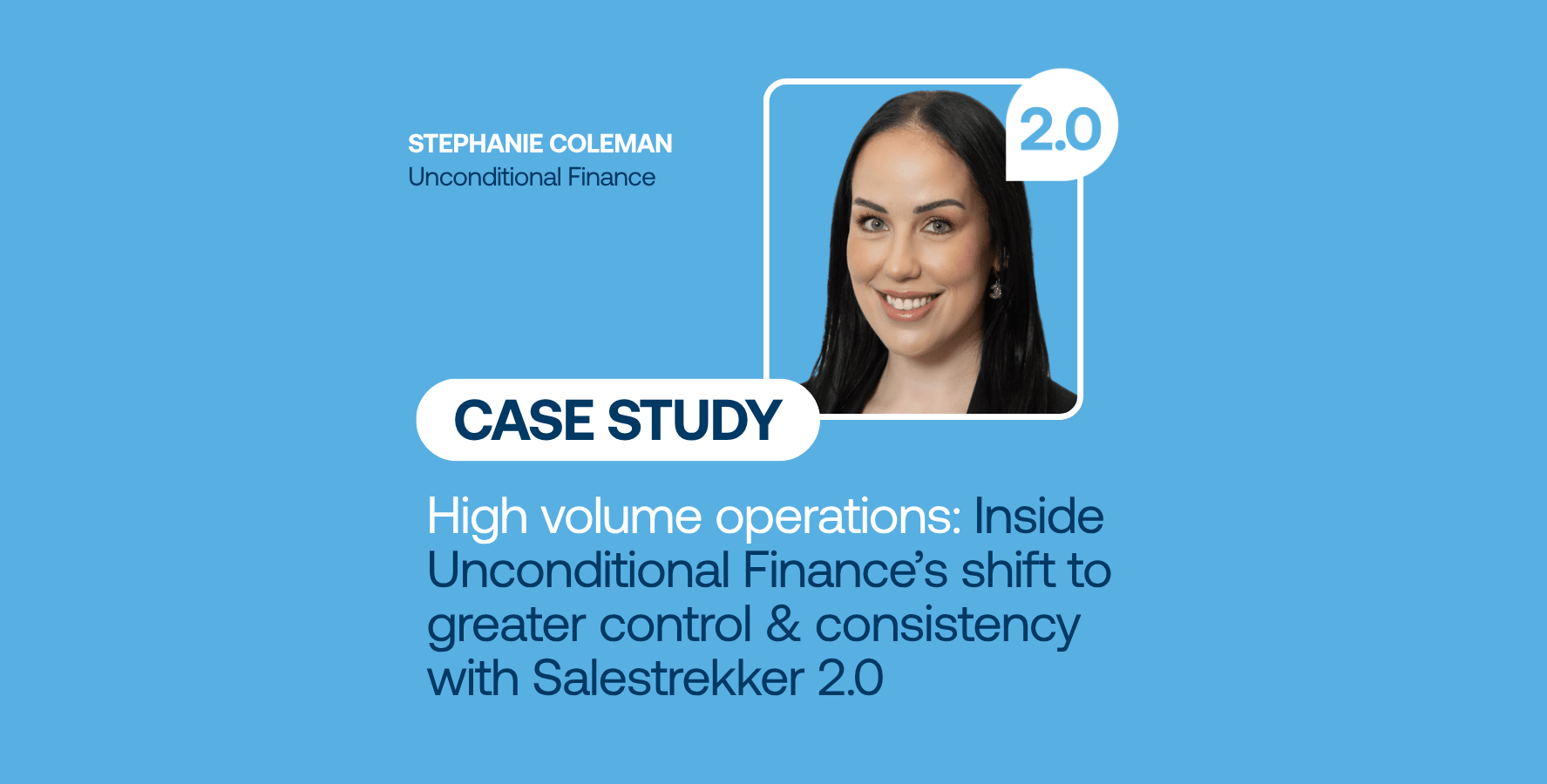
For Operations Manager Stephanie Coleman, that scale creates a practical challenge every day.
“We consider ourselves a high-volume office, and with the number of deals moving through the business, Salestrekker gives us the structure and visibility we need to keep everything on track,” Stephanie says.
Stephanie has been with Unconditional Finance for three years. While she also does some broking work, her main focus is the operations of the business. The team includes 11 people in Australia, supported by offshore staff.
The business also runs an apprenticeship model, where new people often join in entry-level roles and then move through the business as they build their skills. It gives Unconditional Finance a clear way to train people in its own process, rather than asking them to unlearn habits from other businesses.
That makes consistent technology critical. Every broker needs to understand what stage a file is at, what needs to happen next and how each deal should be handled.
A proven platform at the heart of the business
Salestrekker has been part of the Unconditional Finance operating model for several years.
Before Stephanie joined the business, owner and principal broker Chris moved the business to SFG because he wanted access to Salestrekker.
“Chris chose SFG because its technology offering stood out, with access to Salestrekker giving us the platform and capability we needed to support the way we wanted to operate,” Stephanie says.
The business used Salestrekker deeply, with workflows, automations, post-settlement marketing, templates, labels and colour coding all built into the way the team worked. Stephanie describes Unconditional Finance as a Salestrekker “super user”.
That history shaped the move to Salestrekker 2.0. The team was not starting from scratch in how it thought about process. It already knew what good structure looked like, and the work was in rebuilding that structure in the new platform.
Moving the team to Salestrekker 2.0
The move to Salestrekker 2.0 was a major operational project for Stephanie.
She spent hours setting up the platform so it matched the way Unconditional Finance wanted to work. Every broker now uses the same pipeline, automations, labels, colours and workflow structure.
That consistency matters for reporting, but it also matters for training. When everyone works from the same structure, Stephanie can see what is happening across the business and the team can be trained in one clear way of working.
“From an operational perspective, Salestrekker 2.0 helps us create one consistent way of working across the business, so our workflows, deal stages and reporting all align,” Stephanie says.
The team set a firm cutover point. Deals were lodged in Salestrekker until the end of the year, and after the holiday break, all new work moved into Salestrekker 2.0.
Every onshore and offshore team member attended training. Stephanie says the transition came with challenges, but the business worked through them with support from Salestrekker.
She now feels the platform is set up the way the business needs it.
Using AI with care
Unconditional Finance has started using AI broker notes in Salestrekker 2.0, but Stephanie is taking a careful approach.
She uses the tool in her own broking work, and a small number of experienced brokers are also testing it. The wider team will follow once the business has clear rules around when and how AI should be used.
That is especially important because Unconditional Finance uses offshore support. Stephanie does not want offshore staff using AI broker notes until the business is confident they have the right skill level to check the output properly.
“As we introduce Salestrekker’s AI capabilities, we want to make sure our process is watertight and that every output is reviewed with the right level of broker judgement,” she says.
That is where the human element is clear. Salestrekker 2.0 can support better notes, faster workflows and stronger consistency, but Stephanie still sees review, judgement and training as essential. AI is part of the process, but it does not replace broker responsibility.
Compliance, risk and better submissions
For Stephanie, AI broker notes bring two clear benefits. They save time, and they help make sure key compliance points are covered.
“Salestrekker’s AI broker notes save substantial time, but they also give me greater confidence that the key compliance points have been covered,” she says.
That comfort matters in a high-volume business. Missing information can create risk, and it can also slow down an application.
Stephanie sees documents as the biggest compliance risk, but notes also play a critical role. They support compliance file checks and lender submission quality. Clear lender notes explain what the broker is trying to achieve, why that lender was chosen and how the application should be assessed.
If a lender asks a question that has already been addressed, the broker can point back to the notes. If the notes are weak or missing, the business loses that protection.
This is a practical risk issue. A deferral over a simple income question, payslip deduction or loan purpose costs time. In a high-volume office, those small delays add up quickly.
Stronger visibility for the next stage
Salestrekker 2.0 also gives Chris and Stephanie better visibility across the business.
Chris uses Salestrekker to forecast. He can see how many deals are lodged, how many sit in preparation and how many are still at lead stage. Stephanie can view the same information and identify where deals are slowing down.
Labels also help the business act on lost or paused opportunities.
If a client cannot proceed because of various reasons, Unconditional Finance can label the file and target that client later through ActivePipe. If rates drop or property values increase, the team can report on those clients and contact them again.
That is important because 70% of the business comes from existing clients, repeat business and referrals.
“Salestrekker helps us work more effectively with the clients and opportunities already in our business, which is important when so much of our growth comes from repeat business and referrals,” Stephanie says.
Looking ahead
Unconditional Finance is watching the next stage of Salestrekker’s AI tools closely.
AI Audit is high on Stephanie’s list. For a business of its size, audit and compliance are central to protecting growth.
“When you have a business as large and busy as ours, Salestrekker’s compliance and audit capabilities become an important part of protecting the business as it grows,” she says.
The team is also looking forward to portal improvements, including a portal complete button. With 20 to 30 portals out at once, manual checking takes time. A clear completion alert will help brokers respond faster.
Speed matters in those early client stages. The business aims to respond to new enquiries quickly, provide borrowing capacity within 24 hours and send a proposal within 24 to 48 hours after the client portal is complete.
For Stephanie, the first stage of Salestrekker 2.0 has been about setup. The next stage is about seeing the benefit of that work in daily operations.
“I see a lot of potential in Salestrekker 2.0, and I expect the work we have put into the platform will deliver substantial improvements to our efficiency over the next six months,” she says.